Running trade compliance at a new company: how to ramp up quickly and make an impact
A practical guide for trade compliance leads joining a new organization: start from what you actually import, find where the duty sits, and build it into a system your brokers run on.
- Published
- Nov 10, 2026
- Category
- Insights
- Reading time
- 9 min read
Summary
Joining a new company to run trade compliance usually means starting without a playbook. Leadership needs answers, finance wants reports, there are several business units and brokers, and goods still need to clear while you get your bearings.
There's often pressure to start with the system: clean up the part master, classify every part, or scope a new trade tool. A faster route is to work backwards: start from what the company actually imports and pays, find the small group of parts that carry most of the duty and risk, decide what to defend and what to improve, and then build that into your own systems and your brokers' instructions. This guide walks through each step, what to ask for, and what to report back. None of it requires new tools.
Why start from entry data
Cleaning up the part master, or putting a new trade system on top of it, is often the first project a new trade lead is handed. The ERP, and the part master inside it, holds every part the business has ever bought or imported. Much of it is history: parts that are no longer sourced, suppliers that have changed, and classifications entered years ago by people who have since moved on.
What it won't tell you is what you are actively importing today, where your duty exposure sits, or what the company is claiming, or could be claiming, at the border. Starting there means reviewing thousands of records before you know which ones matter. Starting from entry data narrows the work to the records that do. The system work still happens, in Step 6, once you know where to focus.
Step 1: Start with what you actually import
Your first source of truth is what was filed with CBP, not what is set up in the ERP.
- Ask each broker for a part-level report. Cover the last 12 months, or year to date, at the line level: entry number, entry date, part number, HTS number, country of origin, entered value, duty paid and any special program claimed. A few filters in Excel will show your main parts and what you are paying on them.
- Pull your own data from ACE. If the company has an ACE portal account, the ES-003 Entry Summary Line Tariff Details report gives you line-level data across every broker, without depending on any one of them. If no one has portal access, request it early.
- List every importer of record number in use. Larger companies often import under several numbers across subsidiaries and acquired entities. Check what CBP has on file for each one, since inaccurate CBP Form 5106 information can now get a number voided.
- Map your brokers and ports. Note which broker files for which business unit, through which ports, and who your contact is at each.
While you are talking to each broker, check their compliance posture: whether written SOPs exist for your account, whether you have the right contacts, and whether entry packets are shared with you and named by entry number, so you can find any entry when CBP asks for it.
Step 2: Find where the duty sits
Combine the reports and sort by duty paid. In most import programs a relatively small share of parts accounts for most of the duty. Identify the parts that make up about 80 percent of your duty, and separately the parts that make up 80 percent of your entered value.
The two lists overlap but are not the same. A high-value part entering duty free under a preference claim may carry little duty today, and significant exposure if the claim can't be supported.
Then add a risk view. Flag parts subject to Section 232, Section 301, or antidumping and countervailing duties, parts with partner government agency requirements, and parts where a preference such as USMCA is claimed. These are where errors tend to cost the most. The result is a short list of parts that deserves most of your attention in your first months.
Step 3: Look at how those parts are imported
For each part on the short list, build a simple record of how it is entered today:
- Classification: the HTS number on the entry, and whether it is the same across brokers and ports.
- Country of origin: what is declared, and what that determination is based on.
- Preference claimed: USMCA or another program, or nothing.
- Additional duties: whether Section 232, Section 301 or antidumping duties are being paid, and the reporting that goes with them.
- Supplier: who makes the part, and where.
- Broker: who files it, and on what instructions.
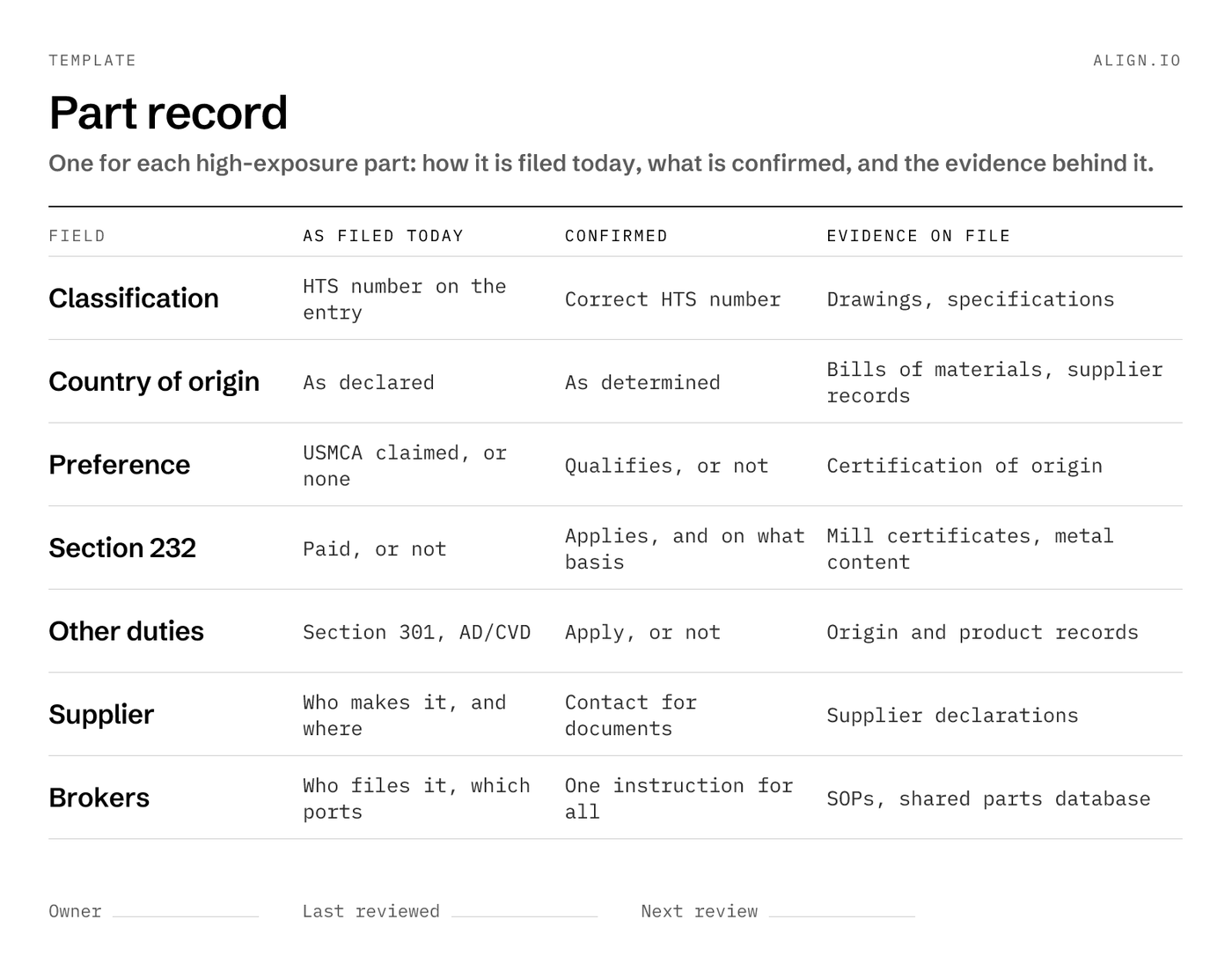
Inconsistencies show up quickly at this stage. The same part classified two ways by two brokers, or claimed under USMCA through one port and not another, is common when no single set of instructions exists.
Step 4: Ask what to defend and what to improve
With that record in front of you, the questions become specific:
- Section 232. Am I paying Section 232 on this part? Should I be? If it applies, do I have the supplier information behind it, such as the part's metal content and where that metal was produced?
- USMCA and other preferences. Am I claiming USMCA? Does the part qualify, and do I have a certification of origin and the records behind it to support the claim?
- Classification. Is the classification right, and could I defend it with drawings and specifications if asked?
- Unclaimed opportunities. What could I be claiming that I'm not? A preference that was never claimed, an exclusion that applies, or duty drawback where imported parts, or the products they go into, are exported.
- Open deadlines. Are any corrections or recoveries time bound? Post summary corrections are only available before an entry liquidates, and protests generally have to be filed within 180 days of liquidation.
Each answer falls into one of two groups. Some claims need defending: you are already making them, and you need the documents to support them. Others are improvements: savings or corrections you can capture once the facts are confirmed. Where past entries look wrong, involve counsel early on whether a post summary correction or a prior disclosure is the right route.
Step 5: Get the documents from the suppliers behind them
Most of the information that supports a claim sits with suppliers, not in entry data. Exposure can be risk or opportunity, so start with the suppliers behind the parts that carry the most of either, rather than sending a blanket request to every vendor.
- Certifications of origin, for USMCA and other preference claims.
- Bills of materials, for origin and content.
- Mill certificates, for where steel and aluminum were produced, under Section 232.
- Drawings and specifications, for classification.
Agree with each supplier on how often documents are refreshed. A USMCA certification of origin can cover multiple shipments of identical goods for up to 12 months, so it needs renewing, and importers claiming USMCA have to keep the records that support the claim for at least five years.
Step 6: Update your systems, then run your brokers from them
Once a part's classification, origin, content and claims are confirmed, record them in your own systems: the ERP, a parts database, or a controlled spreadsheet to start. That record becomes the control plane. Your brokers file from it, rather than from their own histories.
- Share one parts database with every broker, with the approved classification, origin and preference treatment for each part.
- Write or update SOPs for each broker, covering how those parts are filed, what is sent with each shipment, and how changes are communicated.
- Require entry packets to be returned and named by entry number, so you can check filings against your records.
- Review on a schedule. Supplier sourcing changes, and so do tariff rules. Revisit the high-exposure parts regularly, not once.
This is the point to go back to the ERP. You now know which parts matter and what information is still missing, so the cleanup is targeted rather than open ended.
Your first 90 days
In practice the steps overlap, but this order gets you to a first report within a month and a working control plane within a quarter.
Weeks 1 and 2: get the data
Request part-level reports from every broker, pull your ACE data, list your importer of record numbers, and map brokers and ports. Check for open deadlines straight away, since post summary correction and protest windows keep running while you settle in.
Weeks 3 and 4: find where the duty sits
Combine the data, build the short list of high-exposure parts, and start a part record for each one. Close the month with a first report to leadership and finance.
Month 2: defend and improve
Work through the questions for each part, request documents from the suppliers behind them, and bring in counsel on any past entries that need correcting.
Month 3: build the control plane
Record what is confirmed in your own systems, update broker SOPs, share one parts database with every broker, and set a review schedule. Then turn to the ERP.
Showing impact early
Leadership and finance don't need a full audit to see progress. A short report around the end of your first month goes a long way:
- Where the duty sits, by part, supplier and business unit
- What is being defended, and what documentation is still missing
- What can be improved, with an estimate of the savings or recovery
- Which deadlines are open, and what is being done before they close
- What is changing in how brokers are instructed
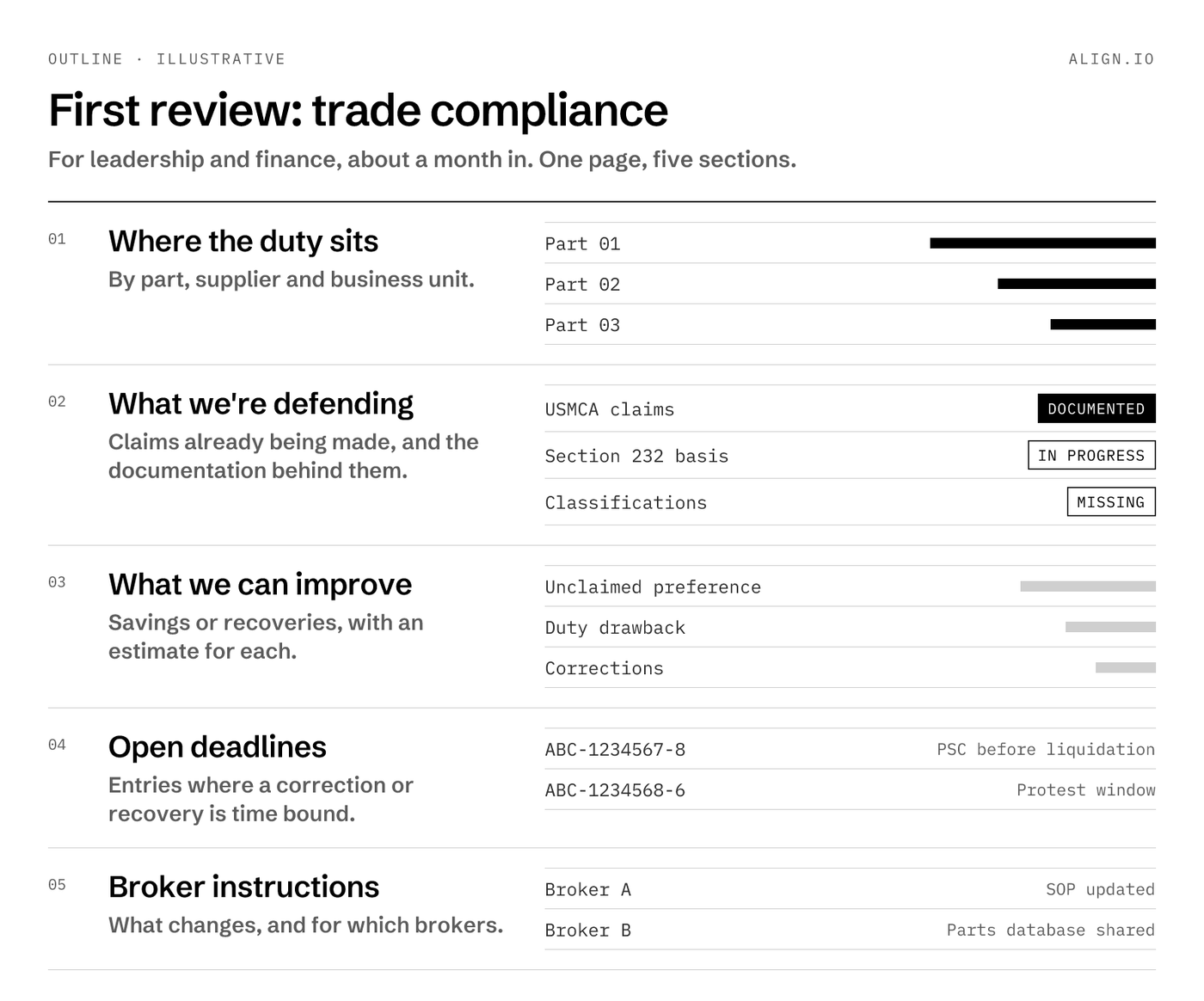
Framed this way, trade compliance reads as a financial function as much as a regulatory one, which is usually what leadership is asking for in the first place.
Looking ahead
What this builds is a financially driven system of action: a way of working backwards from what has actually been imported and paid to decide what happens next, with the parts that carry most of the exposure handled first and handled consistently.
Align is built for this way of working. Its part-level classification records each part's origin and content attributes once, and keeps them consistent and enforced across every broker filing on the company's behalf, with a record that holds up in an audit.
This article is general information and not legal advice.
Keep reading
→ Get started
See your trade operation as it actually is.
Connect your customs and product data. See the exposure, the recovery, and the work worth doing first.